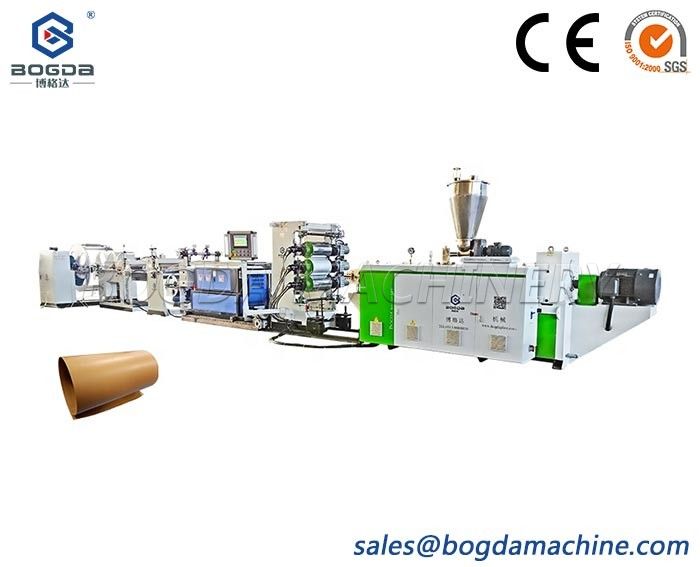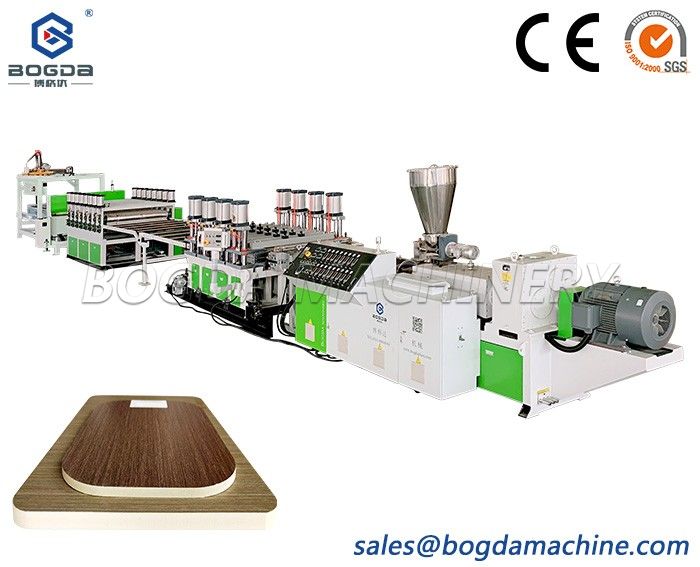
A Plastic Sheet Extrusion Line is a connected set of machines that melts thermoplastic resin, pushes it through a flat die, and forms it into a continuous sheet with a controlled thickness and width. Manufacturers use this equipment to produce material for packaging, construction, appliances, and industrial products. For a business, the right line can help turn resin into consistent, saleable sheet while supporting production planning, material efficiency, and product quality.

In this guide, we explain what a Plastic Sheet Extrusion Line does, which products it can make, how the process works, and what buyers should check when comparing equipment from suppliers such as Bogda.
At its core, a plastic sheet extrusion machine converts prepared resin into a continuous, flat profile. The finished sheet may be wound into rolls or cut into sheets, depending on its thickness, material, and end use. A complete thermoplastic sheet production line may include these components:
Feeding and dosing: Supplies resin and, where needed, additives, colorants, or regrind at controlled rates.
Extruder: Uses a rotating screw and heated barrel to convey, melt, and mix the polymer.
Screen changer and melt pump: Help filter contaminants and stabilize melt delivery when included in the configuration.
Flat die: Spreads the polymer melt into a wide, thin curtain.
Calender or cooling rolls: Set sheet thickness, surface finish, and temperature as the material cools.
Haul-off and winding or cutting equipment: Pull the sheet at a controlled speed and collect it as rolls or cut lengths.
Thickness measurement and controls: Monitor process conditions and help operators maintain the specified product dimensions.
The exact arrangement varies with resin, sheet width, thickness, surface requirements, and output target. A line designed for thin packaging sheet, for example, may not be the right configuration for thick industrial plate.
Once the material and recipe are chosen, the plastic sheet extrusion process follows a sequence of controlled steps. Each stage affects the next, so stable feeding, melt quality, cooling, and haul-off are all important.
Prepare the material. Select the polymer grade and additives. Some materials, including PET, may require drying to limit moisture-related defects. Follow the resin supplier’s processing guidance.
Feed and melt the resin. The screw conveys material through heated zones. Screw design, temperature profile, and screw speed affect melting and mixing.
Filter and deliver the melt. A screen pack can capture contamination, while a melt pump, if fitted, can support more consistent flow to the die.
Form the sheet. The flat die distributes molten polymer across the required width. Die setup and flow balance influence thickness uniformity.
Cool and calibrate. Roll temperature, roll gap, line speed, and cooling capacity help establish final gauge and surface quality.
Inspect and finish. The sheet is measured and checked for defects, then wound or cut to the required format.
Because these variables interact, a production trial using the intended resin and product specification is more informative than choosing a line from maximum output alone.
A Plastic Sheet Extrusion Line can produce sheet from a range of thermoplastics. The achievable product depends on the line design, material grade, tooling, and downstream equipment. Common materials and applications include:
| Material | Typical sheet applications | Important considerations |
|---|---|---|
| PET and recycled PET | Thermoforming sheet for trays, lids, and food or consumer packaging | Moisture control, melt filtration, clarity, and recycled-content consistency |
| PP | Packaging, stationery, folders, and thermoformed containers | Grade selection, impact performance, and forming behavior |
| HIPS and GPPS | Refrigerator liners, disposable packaging, and display components | Impact strength, surface quality, and any required coextruded layers |
| ABS | Appliance panels, automotive interior components, and protective covers | Heat management, surface finish, and downstream forming needs |
| PE and PVC | Protective, construction, and industrial sheet products | Resin-specific processing windows and applicable product requirements |
Depending on the configuration, an extrusion line may also produce multilayer sheet through coextrusion. This lets manufacturers combine materials or layers for properties such as a functional barrier, a colored surface, or recycled content beneath a virgin-material skin layer. Not every line supports every resin or structure, so confirm compatibility with the equipment supplier.
Sheet dimensions and consistency can affect what happens after extrusion. A thermoformer, for instance, needs sheet that heats and forms predictably. A construction or industrial customer may instead prioritize stiffness, impact resistance, surface finish, or flatness. A stable process helps reduce off-spec material and makes it easier to meet the needs of downstream converting operations.
For a manufacturer evaluating Bogda equipment, the practical question is not simply whether a line can extrude plastic. It is whether the proposed configuration can run the intended material, achieve the required sheet dimensions, integrate with downstream equipment, and support the expected production schedule. Ask for a proposal based on your product specification and, where possible, a material trial.
Different polymers have different melting behavior, viscosity, drying needs, and processing windows. Screw design, barrel capacity, die, venting, and temperature controls must suit the target resin and product. Confirm the proposed material range rather than relying on a broad statement that a line is suitable for “plastic.”
A quoted maximum throughput may depend on a specific resin, sheet width, thickness, and operating setup. Ask what conditions apply to the figure, and distinguish gross output from saleable output after trim, startup material, and quality rejects.
A thickness gauge can measure and help control sheet gauge, but achievable tolerance depends on the full system, calibration, resin behavior, line speed, and measurement method. A target such as 0.01 mm should be treated as a requirement to validate on the actual product—not as a universal guarantee for every line or material.
Recycled feedstock can vary in moisture, contamination, melt flow, and color. Drying, filtration, blending, and process settings may need adjustment. Test the intended recycled resin percentage and quality before committing to a production specification.
Quality requirements depend on the material and end use. Standards provide defined test methods, but they do not automatically certify a sheet or a machine. Agree on the sampling plan, specimen preparation, conditioning, and acceptance limits with your customer or laboratory.
ASTM D638: Tensile properties of plastics.
ASTM D790: Flexural properties of unreinforced and reinforced plastics.
ASTM D1003: Haze and luminous transmittance of transparent plastics.
ASTM D570: Water absorption of plastics.
These methods are relevant only where the property matters to the product. Buyers should also define dimensional checks for thickness and width, appearance criteria for gels or streaks, and any food-contact or regulatory requirements separately. For example, a 100% inspection policy may be suitable for a particular high-risk application, but the inspection method and defect limits must be specified rather than assumed.
Consider a packaging manufacturer planning to make PP sheet for thermoformed containers. The team first defines the sheet width, thickness range, color, forming process, and target output. It then confirms that the proposed extruder, flat die, cooling rolls, and haul-off can handle the selected PP grade and the intended production rate.
During a trial, operators record actual output, gauge variation across the web, roll temperature, startup scrap, and thermoforming results. If the sheet forms unevenly, the team investigates material consistency, heating conditions, thickness profile, and forming settings rather than assuming the extruder alone is responsible. This example is illustrative: actual results depend on the material, product design, line specification, and operating conditions.
When discussing a Bogda Plastic Sheet Extrusion Line or another supplier’s proposal, prepare the information needed to match the equipment to your production goals:
List the resin grades, virgin or recycled content, and any additives you plan to use.
Specify sheet width, thickness range, layer structure, surface finish, and roll or cut-sheet format.
State the required saleable output and the operating hours or shifts expected.
Ask what resin and product conditions are used for quoted output and thickness figures.
Review included components, controls, utilities, installation needs, operator training, and maintenance access.
Agree on acceptance criteria and a commissioning test using representative material.
For production planning, also compare energy use, scrap handling, changeover time, spare parts, and compatibility with your downstream thermoformer or converting equipment. A specification review and test plan can help prevent a mismatch between the line and the product you intend to sell.
A Plastic Sheet Extrusion Line melts thermoplastic resin and forms it into continuous sheet for packaging, construction, appliance, and industrial applications. Its output depends on resin selection, screw and die design, cooling, line controls, and downstream handling. Standards such as ASTM D638, D790, D1003, and D570 can support material testing when relevant, while product-specific trials verify real operating performance.
In short, define the sheet before selecting the equipment. Share your material and production requirements with Bogda, compare the proposed configuration against those requirements, and validate critical dimensions and properties through a documented trial. That is the practical way to determine whether a plastic sheet extrusion machine can produce the sheet your business needs.
 Previous: None


Copyright © Bogda Machinery Group All Rights Reserved | Sitemap